
The 7th edition of the World Championships is in full swing in Hanover, bringing together people with different stories and backgrounds, all competing side by side.
A poster bearing a slogan looks just like something you might see in the stands at a football stadium. But this is a friendly greeting from two clubs, displayed along the spectator side of Swiss Life Hall. “We’re taking part. PPParkinson World Championships 2026 Hanover” reads the sign, written and illustrated by SG Sendenhorst and SVD Drensteinfurt. What lies behind it? A great deal – and a story that is in many ways representative of the spirit of the event at the Academy of Sports in Hanover.
Karo Farys has travelled to Hanover with Herbert Steinbrink, her father, who is competing in the tournament and receiving support from his daughter, who is accompanying him as his carer. It is currently a break between matches, and Karo is enjoying a few rallies at an unoccupied table with Judith Kleinebenne, who is also competing in the PingPongParkinson World Championships and is herself living with Parkinson’s disease.
“We met in the summer,” the two say in unison before embracing. They first met at a Parkinson’s table tennis tournament in eastern Westphalia, and a friendship has grown from that encounter.
Parkinson’s disease has shaped much of their lives, both in terms of its everyday effects and the opportunities it has created through club-based sport. “My father can do everything on his own, and his medication keeps things under control. Table tennis has made a lot of things better, too: he is more mobile, his hand is steadier, and the overall progression of his Parkinson’s has become milder,” explains Karo Farys, recalling how it all began.
Her father was diagnosed ten years ago. In 2021, she saw a television report about how table tennis can help people with Parkinson’s and learned about a club in Münster offering the sport to people affected by the disease. From Sendenhorst, a town southeast of Münster, it was only a short journey. The visit proved successful – and, above all, led to something lasting.
Karo Farys began asking around in her hometown and the surrounding area, and the response led to the establishment of organised Parkinson’s table tennis groups at local clubs. Today, SG Sendenhorst has eight players, while SVD Drensteinfurt has six. All of them are competing in Hanover. Her father was also responsible for the poster. “Including our carers, there are actually 25 of us here,” says Karo Farys.
Judith Kleinebenne was diagnosed with Parkinson’s at the age of 40. “The doctors examined everything back then, but ruled out Parkinson’s because I was a woman and supposedly far too young,” says the player from SV Etteln, south of Paderborn. Now 52, she is among the younger participants at the PPP World Championships.
She lives with a deep brain stimulator, often referred to as a brain pacemaker. “And with that, she can live a completely normal life,” says Karo Farys, embracing her friend once again. Without the device, however, the right side of Judith Kleinebenne’s body would be paralysed, she explains.
Kleinebenne has been playing table tennis for just two years. “That was the first time I ever held a racket – and now I’m playing in my first World Championships. I’ve even made it through the group stage in all my events,” she says proudly.
In Etteln, she has since established a local training centre and has also run another one in Gütersloh. “I play table tennis three times a week. I can’t imagine anything better. It’s all like one big family.”
Further information:
Text: Stephan Hartung
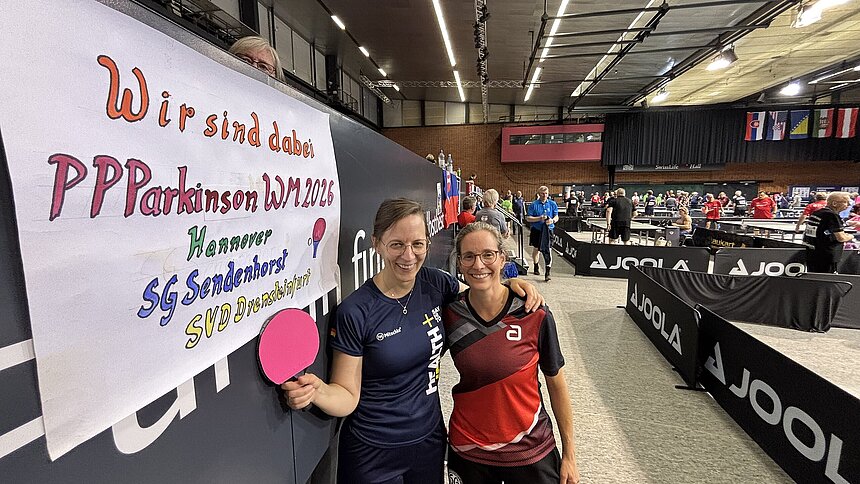
Photo caption: Judith Kleinebenne (left) and Karo Farys met through table tennis and have now reunited in Hanover. ©Stephan Hartung